
Movie Review
JOKER: FOLIE À DEUX

by Anwaya Mane
Cast: Joaquin Phoenix, Lady Gaga, Robert De Niro, Zazie Beetz // Written by Scott Silver and Todd Phillips // Directed by Todd Phillips
Phoenix and Gaga’s madness of two stays subservient to the Clown Prince of Crime’s enigma.
The iconic line from Christopher Nolan’s 2008 film The Dark Knight says, “You either die a hero, or you live long enough to see yourself become the villain.” Spoken by Harvey Dent (Aaron Eckhart) to Bruce Wayne/Batman (Christian Bale), it resonates far beyond its original context. While the film famously reintroduced the Joker (the late Heath Ledger) to a new generation of comic book fans, the quote now takes on an ironically relevant new meaning in light of the recent standalone film Joker: Folie à Deux.
The film stars Joaquin Phoenix as Arthur Fleck/The Joker and Lady Gaga as Harley "Lee" Quinzel. This sequel deepens the psychological descent of its central character, reflecting Dent’s warning in a disquieting and literal way.
The film opens with an animated short titled Me and My Shadow, where Arthur’s shadow causes trouble, misbehaving with a woman and sabotaging Arthur’s reputation on live television, while Arthur himself takes the fall for the mischief. This dynamic echoes what we saw in Joker (2019). Two years after the events of the first film, a gaunt Arthur Fleck is quietly serving his prison sentence. Guards taunt him, urging him to tell a joke, but he remains silent. The film builds a tense, almost frightening anticipation; you’re constantly waiting for Arthur to strike, retaliate, lash out, or kill. But instead, he remains eerily composed, unnervingly still.
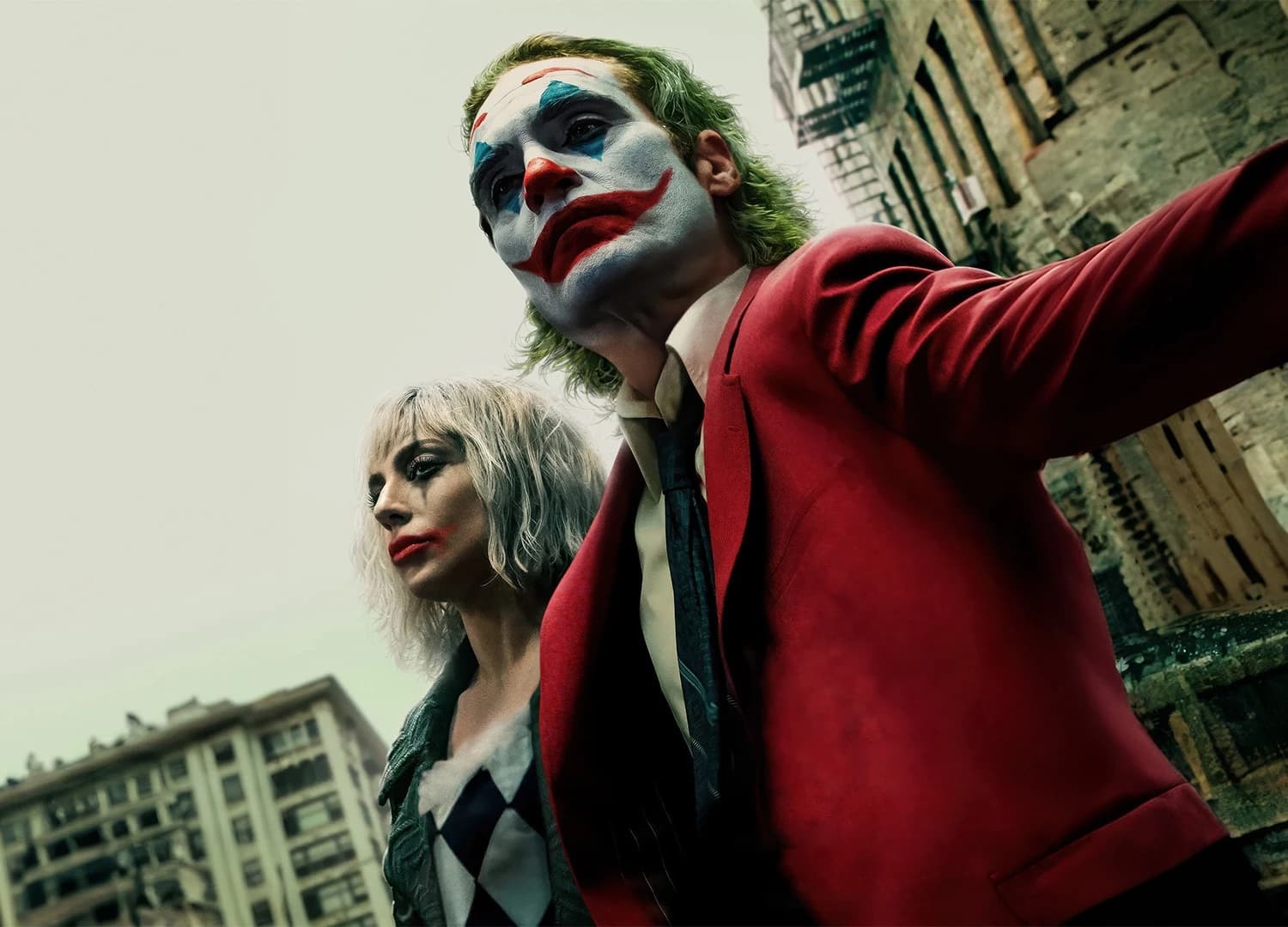
That is, until he meets Harley, also known as "Lee." She confides in Arthur about her traumatic past: she endured years of abuse at the hands of her father, who later died in a car crash. In a desperate and volatile moment, she set her family's apartment on fire, which ultimately led to her being committed to Arkham State Hospital. Seeking a connection with Arthur, she even claims they grew up in the same neighborhood.
Imprisoned at Arkham State Hospital, the troubled and socially isolated Arthur is regularly bullied by fellow inmates and guards. But with Harley's arrival, he feels as if new life has been injected into his veins. The two unhinged souls sing and dance together, confess dark truths like “I killed my mother”, with the casual ease of discussing grocery prices, unleashing chaos that feeds into the film’s neurotically charged atmosphere.
"Folie à Deux" is a French term that literally translates to "shared madness" or "madness of two." Initially, I assumed it referred to Gaga and Phoenix, but in reality, it speaks more profoundly to Arthur and the Joker, two fractured halves of the same person. It’s a psychological duel between the self we present to the world and the one we bury deep within. The Joker isn’t just Arthur’s alter ego; he is the unmasked truth, the pure, chaotic essence of who Arthur really is. Together, they create a disturbing yet mesmerising synthesis – a broken mind in perfect, terrifying harmony with itself. It’s this collision, this unravelling of identity, that makes Folie à Deux material for drama, for cinematic gold.
In another world, Arthur and Harley might have been dancing a joyful tango, chasing Hollywood dreams in Los Angeles—perhaps in a heartbreaking musical directed by Damien Chazelle. But elect a clown, and you get a circus. Comic book fans have long idolized, worshipped, and been in awe of the Joker, the "Clown Prince of Crime." The much-anticipated sequel, however, is a recipe for chaos and commotion.
The film attempts to pay tribute to this iconic character, at times reverent, at times teasing, as if provoking a reaction. On a deeper level, it’s a folie à deux between the filmmaker, Todd Phillips, and the comic book fandom – a mutual obsession with a character too complex, too chaotic, to ever be fully contained.
Personally, I enjoyed Joker: Folie à Deux for the most part, but there's no denying that the film often feels consumed by its own pop-culture weight – the legacy of its protagonist and the pressure to cater to the audience's perception of the Joker. As a comic book fan, I understand the immense challenge of living up to the character’s mythos. But as a lover of cinema, I found myself wanting more – more daring, more depth, and perhaps a clearer vision unburdened by expectation.
The music by Hildur Guðnadóttir weaves seamlessly into the fabric of the film, enhancing its emotional depth and unsettling atmosphere.
Joaquin Phoenix is incredibly sublime – his masterful body acting, stress-induced laughter, and skeletal frame paint the portrait of a man both unhinged and strangely solemn. Lady Gaga pours herself into the role, and together they craft a dynamic exchange of misery, mayhem, and mania. They propel a 2-hour, 18-minute cinematic whirlwind. Yet, despite their commanding performances, both remain subservient to the enduring enigma of the "Clown Prince of Crime."
This brings me back to the opening lines of this review and to a new perspective. In many ways, the film has outlived the legacy of its unparalleled protagonist. Joker: Folie à Deux seems to have lived long enough to see itself become a villain: a hollow monument to the chaos it once authentically embodied. It desperately wants audiences to leave feeling what the Joker evokes – magnetism, rebellion, and the thrill of disruption. But in its quest to become the Joker, it more successfully captures Arthur: a flawed, broken man, consumed by longing, and crushed under the weight of his own impostor syndrome.
And perhaps, in the end, that is the true folie à deux - not just between Arthur and Harley, or Arthur and Joker, but between the film itself and the myth it is trying so hard to become.