
by HASAN BEYAZ
Photos courtesy of RT. COLEMAN
September 2025 saw K-pop solo star WONHO return to Europe for his second headline show since 2022, and at Shepherd’s Bush Empire it was obvious from the opening moments that this wasn’t a repeat performance. In the years since his debut, he’s grown from a charismatic showman into a fully realised artist – one whose songwriting, vocal precision, and stagecraft demand as much attention as his visuals.
Reducing him to visuals alone is a lazy shorthand that ignores the fact he’s heavily involved in writing, composing, and arranging his own music, and that he’s quite simply one of the best soloists in K-pop. For the fans, that’s never been in question. For anyone else still stuck on surface-level impressions, his Stay Awake tour makes his artistry impossible to overlook.
<h3>This wasn’t about proving his worth – WONHO’s multi-faceted artistry already speaks for itself – but about showing, in real-time, why he deserves to be taken seriously as a musician</h3>
What London got was the full spectrum: choreography sharp enough to rival any group act, vocals that swung from tender to thunderous, and quiet, introspective pauses that revealed the songwriter behind the spectacle. This wasn’t about proving his worth – WONHO’s multi-faceted artistry already speaks for itself – but about showing, in real-time, why he deserves to be taken seriously as a musician, and why his fans (known as WENEE) never doubted him in the first place.
The show kicked off with his latest English single “Better Than Me,” its hook – “no one does it better than me” – landing with the kind of unshakable confidence that set the tone for the night. The choreography was all body rolls and floor-sweeping sensuality, but beneath the spectacle sat a clear message: self-love, self-worth, and the refusal to shrink. From there, “With You” and “Eye On You” kept the energy climbing, while the first act closed with a trio of “Blue,” “Best Shot,” and “Devil” – songs that threaded polished production with flashes of vulnerability, hinting at the duality that runs through much of WONHO’s work.
The pace shifted as the first VCR rolled. Against a backdrop of cheering crowds and flickering lightsticks, his voiceover cut in with raw questions: “Why do I want to stand on this stage?”
Handwritten lyrics from the ballad “WENEED” flickered onscreen – “When I’m back on the stage, can you wave your hands again?” – as a reminder of the bond that’s carried him through. “Not once have I forgotten the light and the cheers. To stand before you again, I keep walking even today.” The sincerity hit hard. It framed performance not as a job but as an extension of who he is: a musician drawing strength from the people who show up for him. For casual fans, it’s an invitation to look deeper; for WENEE, it felt like confirmation of a dialogue that never really ended.
<h3>While fan appreciation is baked into the DNA of K-pop, few artists channel it as viscerally as WONHO. “Losing You" followed “Stranger,” and the mood in the room shifted again.</h3>
This intimate segment is part of the Between Dreams portion of the set. A stool is brought out, and WONHO steps softly into the spotlight, wearing a youthful varsity jacket and jeans – a striking contrast to the sophistication of the opening act’s custom-made, bedazzled suit. The acoustic guitars of “Stranger” begin, and suddenly the focus is entirely on him as a musician. The track runs solely on a simple acoustic line, and a voice unguarded. If anyone still thought of him as “just visuals,” this was the moment that shattered that.
“Stranger” perfectly illustrates the diversity of his catalog and the undercurrents of his artistry: vulnerable, introspective, and tinged with melancholy. He accesses his falsetto with ease, and the chorus line – “Sometimes I feel like a stranger / All alone” – lands with a lived-in ache; the fact that he co-wrote, co-composed, and co-arranged “Stranger” only deepens the authenticity. This is acutely where WONHO’s artistry cuts deepest: his rare ability to translate the nuances of feeling like an outsider “all alone” into music that resonates with anyone who’s ever carried that same weight. The simplicity of the stage setup here ensures you can’t escape that intimacy; you are compelled to listen, and feel it deeply. It’s a deliberate and smart artistic choice that literally puts his talent in the spotlight.
While fan appreciation is baked into the DNA of K-pop, few artists channel it as viscerally as WONHO. “Losing You" followed “Stranger,” and the mood in the room shifted again. Originally his first step into solo work back in 2020, the song now carries the weight of everything he’s lived since – new creative chapters, the ongoing push to define himself beyond the obvious. Performed live, its duality as less about heartbreak in the abstract and more about a promise to his fans is more palpable than ever. The hush that fell across the crowd said it all: this was memory, connection, and gratitude rolled into one.
From there, “Close” nudged the atmosphere upward without breaking it completely. Its R&B sonics are brighter, but the thread of solitude still murmurs underneath, a reminder of how often WONHO’s songs wrestle with connection: yearning for it, holding onto it, or fearing its loss. On stage, the track pulled between joy and ache, and his vocal delivery kept it suspended in that tension. What could have been a straightforward pop moment instead landed as something layered: vulnerable but still accessible, universal in its ache for belonging.
<h3>Across the night, WONHO’s mastery was evident in the balance he struck: arena-level choreography and stage tricks woven seamlessly into a theatre setting, but it’s his songwriting, vocal control, and ability to navigate emotion that prove his credibility.</h3>
Then the tempo snapped back with a run of high-octane cuts: ”Ain’t About You” with its sly swagger, the hip-hop bounce of “24/7”, and the adrenaline punch of “Crazy.” It wasn’t just an energy spike for its own sake; the sequencing highlighted his range, showing how cleanly he can flip from stripped-down confessionals to full-throttle spectacle without breaking the thread of the story. It’s versatility that feels deliberate rather than scattered – proof of the different shades of his artistry, every track slotted with purpose.
Another VCR follows, diving headfirst into “the emotional weight of ARTIST WONHO.” It’s candid without being overblown – more like peeking into a private journal than watching a staged interlude, grounding the spectacle in something rawer.
The third act, All For You, opened with a power move: two unreleased songs. “MALA,” sultry and cinematic, leaned into a darker sensuality; “Down” arrived like it had always belonged in the setlist, pulsing with club-ready abandon and chants already spilling back from the crowd. Rather than leaning on old favourites, these debuts felt like statements – proof that he’s building the next phase of his career in front of us, and inviting the audience to be part of it.
From there, “What Would You Do” offers a poignant marker of his post-military return: still vulnerable, still reflective, but with a newly sharpened accessibility that suggests where his artistry is heading next. And then come the big guns: “Lose” and “Open Mind.” The former’s swelling intensity sets up the latter’s sleek electro-funk groove, which remains as futuristic and intoxicating as it did back in 2020. Ending the main set with “Open Mind” feels like a deliberate full-circle moment – closing the arc where his solo career took off, while simultaneously proving that the music hasn’t lost its edge against everything else that came afterwards in his catalog.
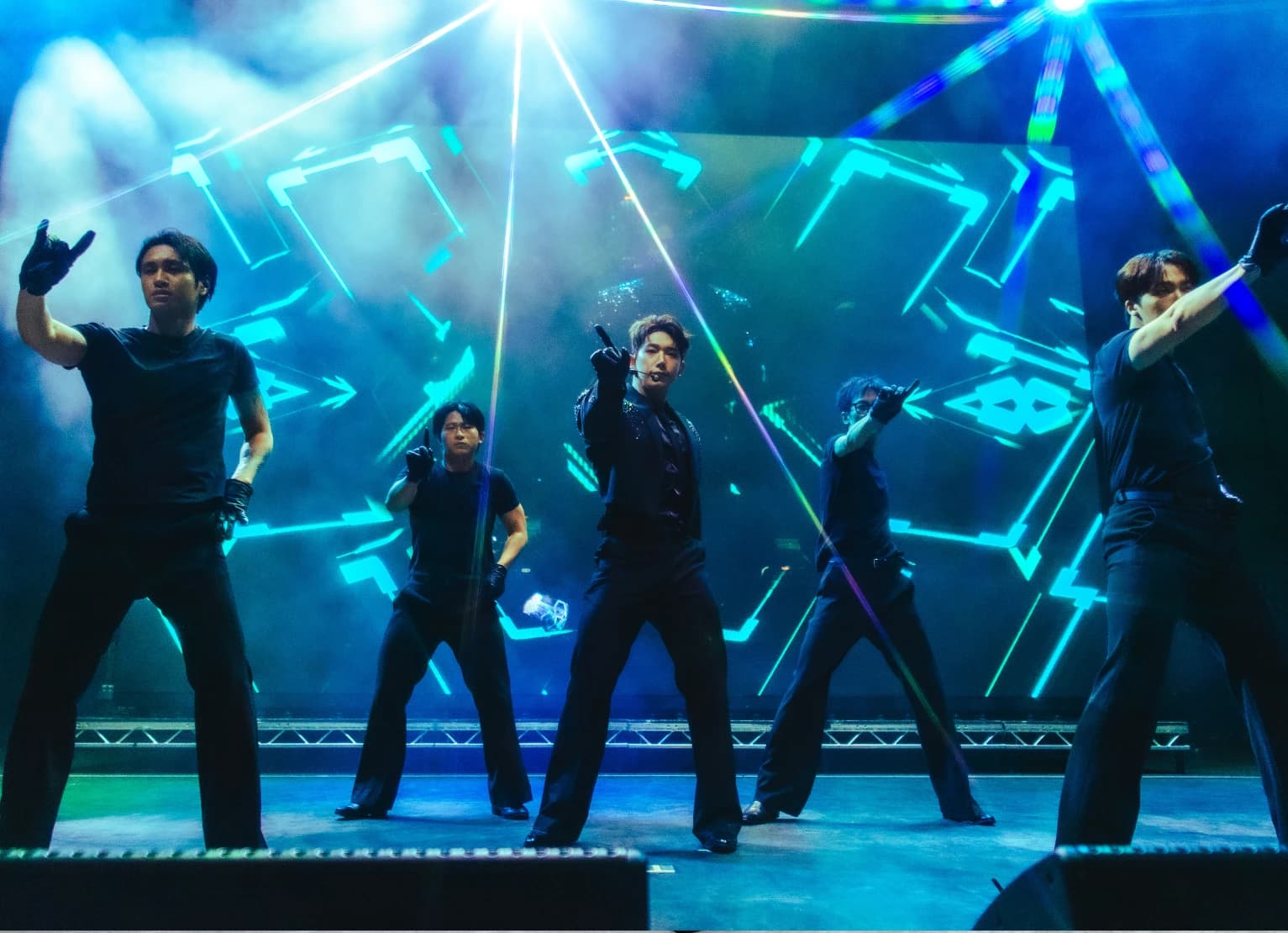
Encores in K-pop are usually the point where walls drop, and WONHO’s was no different. The yearning lyrics of “Somebody” reopened the night on a tender note before “Down” came roaring back – a future-hit so infectious that even the crew at the wings couldn’t stop moving. “Crazy” returned unannounced, spiralling into chaos as WONHO vaulted off stage, diving into the crowd with water bottles flying, riffs dropping lower than he ever pushes on record, and a looseness that made the moment electric. Unplanned and thrilling, it was another glimpse of an artist who knows how to harness spontaneity as much as precision.
The finale, “Flash,” fused spectacle with sentiment; it was the closing bridge – “You’ve given me so much, I still have more to give you back” – that hit hardest. As an ending statement, it felt profound: a distillation of his ethos as a performer and his devotion to WENEE. The show may have been over, but the message was clear: WONHO’s story, and his artistry, are still unfolding.
Across the night, WONHO’s mastery was evident in the balance he struck: arena-level choreography and stage tricks woven seamlessly into a theatre setting, but it’s his songwriting, vocal control, and ability to navigate emotion that prove his credibility. A setlist that told a story rather than simply ticking boxes. For casual observers, the “eye candy” narrative should have been put to bed here; for WENEE, it was simply confirmation of what they already knew.
By the end, what lingered wasn’t the abs, or even the spectacle, but the music – the songwriting, the craft, the vulnerability – and the fact that WONHO, more than ever, deserves to be seen as a musician first.